Why I Finally Found Calm Through Qigong — A Beginner’s Real Story
Stress used to rule my days—racing thoughts, tight shoulders, endless fatigue. I tried meditation, breathing apps, even journaling, but nothing stuck. Then I stumbled on qigong, an ancient Chinese wellness practice that felt different from the start. As a total newbie, I was skeptical, but within weeks, something shifted. This isn’t about miracles—it’s about small, consistent movements that quietly rewired my nervous system. Here’s how I learned to release stress naturally, one breath at a time.
The Breaking Point: When Stress Became Too Much to Ignore
For years, I managed what I thought was a normal level of stress. Juggling work, family, and household responsibilities felt like a full-time job on top of my actual full-time job. I’d wake up already tired, shoulders tense as if carrying invisible weights. My mind raced from the moment my alarm went off—what needed to be done, who needed what, what I might have forgotten. I’d rub my neck constantly, unaware that the tightness had become a permanent companion.
Sleep offered little relief. Even when I managed to lie still, my thoughts wouldn’t quiet. I’d replay conversations, worry about deadlines, or plan tomorrow’s schedule. I tried everything: herbal teas, sleep masks, guided meditations downloaded from wellness apps. I even kept a journal by my bed, writing down worries in hopes of releasing them. But the relief was temporary. The fatigue deepened, and I began to notice a mental fog that made it hard to focus. Simple decisions felt overwhelming.
The turning point came during a routine doctor’s visit. My blood pressure was elevated, and I admitted I hadn’t felt truly rested in months. My doctor didn’t prescribe medication but gently suggested I look into stress management beyond conventional methods. She mentioned mind-body practices—things like tai chi or qigong—that had been studied for their calming effects. I’d heard of tai chi, but qigong was new to me. It sounded vague, maybe even a little mystical. But I was out of options. I decided to explore it, not with hope, but with a quiet desperation.
What Is Qigong? More Than Just Movement
At its core, qigong (pronounced “chee-gong”) is a practice that combines gentle physical movement, focused breathing, and mindful awareness. The word itself comes from Chinese: “qi” meaning life energy or vital force, and “gong” meaning cultivation or practice. So, qigong translates to “cultivating energy.” But you don’t need to believe in energy fields to benefit from it. Think of it as a system designed to harmonize the body and mind through rhythm, breath, and intention.
Rooted in traditional Chinese medicine, qigong has been practiced for thousands of years to support health, prevent illness, and enhance vitality. Unlike high-intensity workouts or complex yoga poses, qigong is accessible to nearly everyone. It doesn’t require flexibility, strength, or prior experience. You can practice it standing, sitting, or even lying down. The movements are slow, deliberate, and repeated—more like flowing sequences than exercises. Each motion is coordinated with the breath, creating a natural rhythm that calms the nervous system.
One common misconception is that qigong is religious or esoteric. While it has philosophical roots, modern qigong is often taught in secular, health-focused contexts. It’s not about chanting or mystical experiences. It’s about paying attention—how you breathe, how you move, how you feel in your body. Another myth is that it’s only for older adults or people with chronic conditions. In reality, people of all ages and fitness levels practice qigong to improve focus, reduce anxiety, and build resilience. It’s not a performance; it’s a personal practice, done at your own pace.
Why Qigong Works for Stress—The Science Behind the Calm
What makes qigong effective for stress isn’t magic—it’s physiology. When we’re stressed, our sympathetic nervous system activates, triggering the “fight-or-flight” response. Heart rate increases, muscles tense, and cortisol—the stress hormone—surges. This is helpful in emergencies, but when it’s constantly activated, it wears down the body. Qigong helps shift us into the opposite state: the parasympathetic nervous system, which governs “rest and digest.”
Slow, rhythmic movements synchronized with deep breathing act as a natural reset button. Studies have shown that regular qigong practice can reduce cortisol levels, lower blood pressure, and improve heart rate variability—a key marker of resilience. One review published in the Journal of Psychosomatic Research analyzed multiple clinical trials and found consistent evidence that qigong significantly reduces perceived stress and anxiety. The practice appears to interrupt the loop of repetitive, anxious thoughts by anchoring attention in the present moment through movement and breath.
The mind-body connection is central to qigong’s effectiveness. Unlike passive relaxation techniques, qigong engages both physical and mental awareness. As you move, you’re encouraged to notice sensations—the warmth in your palms, the rise and fall of your chest, the grounding of your feet. This dual focus prevents the mind from spiraling into rumination. Over time, this builds what scientists call interoceptive awareness—the ability to sense and respond to internal bodily signals. This skill is linked to better emotional regulation and reduced reactivity to stressors.
Additionally, the repetitive nature of qigong movements has a meditative quality. It doesn’t require you to “clear your mind,” which can feel impossible when stressed. Instead, it gives your attention a simple task: follow the breath, follow the motion. This gentle focus reduces mental chatter without effort. It’s like giving your overactive brain a soft place to land.
My First Week: Skeptical but Showing Up
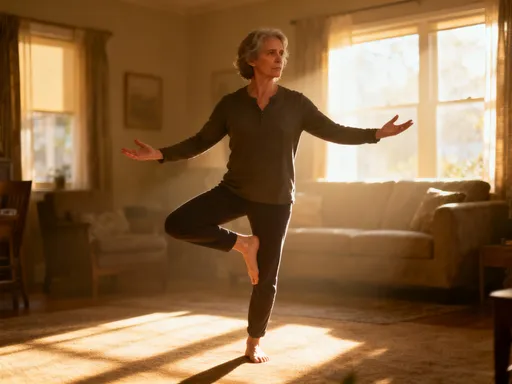
I started with a 10-minute beginner video I found online. I stood in my living room, feeling a little self-conscious. The first movement—lifting the arms slowly in front of me, then overhead—felt awkward. I worried I was doing it wrong. My arms trembled slightly, not from exertion, but from the unfamiliarity of moving so slowly. I kept glancing at the screen, trying to mirror the instructor. My mind wandered: Is this working? Am I supposed to feel something?
By the third day, I almost quit. Nothing dramatic had happened. No sudden calm, no deep insights. I still felt tired. But I committed to seven days, so I kept going. On the fifth morning, something subtle shifted. I woke up and realized I hadn’t checked my phone immediately. Instead, I sat on the edge of the bed and took three slow breaths—something I’d picked up from the practice. Later that day, during a stressful email exchange, I noticed my shoulders tensing and automatically softened them, remembering the instructor’s cue: “Relax into the movement.”
The biggest change came in my sleep. On the sixth night, I fell asleep faster. Not instantly, but without the usual mental loop of worries. I didn’t think much of it at first, but when it happened again the next night, I began to wonder. Maybe it wasn’t the herbal tea. Maybe it was the 10 minutes of slow motion and breathing. I still didn’t feel transformed, but I felt a flicker of hope. I realized progress wasn’t about dramatic breakthroughs—it was about small, almost invisible shifts that accumulated over time.
Simple Moves That Made a Difference—A Beginner’s Toolkit
Three foundational qigong exercises became the core of my daily routine. They’re simple, require no equipment, and can be done in a small space. I practiced them for 5–10 minutes each morning, gradually increasing to 15 as I became more comfortable.
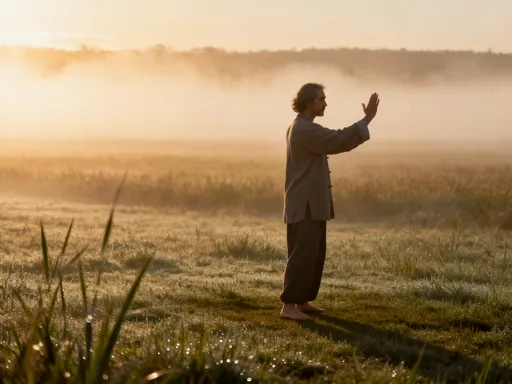
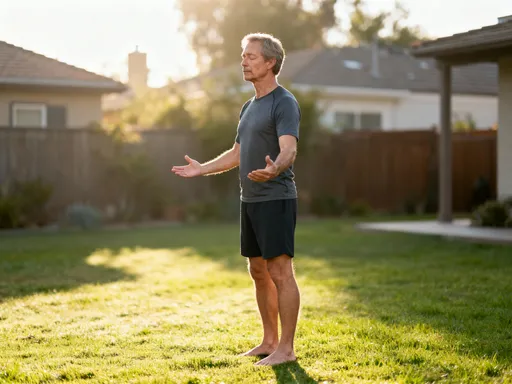
The first is called Lifting the Sky. Stand with feet shoulder-width apart, knees slightly bent. Inhale slowly as you raise your arms in front of you, then overhead, as if gently lifting a large ball above your head. Keep the movement smooth and relaxed. Exhale as you lower your arms back down, palms facing down. Repeat 6–9 times. This movement encourages deep breathing, stretches the torso, and creates a sense of upward expansion. It helps release tension in the shoulders and chest, areas where stress often accumulates.
The second is Separating Heaven and Earth. Start in the same stance. Inhale as you raise one hand overhead, palm facing up, while the other hand lowers to your side, palm facing down. Imagine drawing energy from the earth with your lower hand and receiving it from the sky with the upper hand. Exhale as you switch sides. Repeat 6–9 times on each side. This movement promotes balance and grounding. It fosters a sense of connection between the body and the environment, which can be soothing when feeling scattered or overwhelmed.
The third is Shaking the Body. Stand with knees soft and arms relaxed. Gently bounce on the balls of your feet, allowing your arms and hands to shake freely. Let your head and spine move loosely. Do this for 1–2 minutes. This may look unusual, but it’s incredibly effective for releasing physical tension. It mimics the natural shaking response animals use to discharge stress after a threat has passed. Many practitioners report feeling lighter and more relaxed after just a minute of shaking.
When practicing, I focused on a few key principles: keep the movements small and gentle, breathe naturally through the nose, and avoid straining. I learned that consistency mattered more than duration. Even on days when I felt too busy, I’d do just one round of Lifting the Sky while waiting for the kettle to boil. Over time, these micro-moments added up.
Building a Habit Without Pressure
One of my biggest fears was that I’d fall off track. I’ve started and abandoned so many wellness routines—yoga, meditation, even daily walks. What made qigong different was its low barrier to entry. Because the sessions were short and required no special clothes or equipment, it was easy to fit into my day. I didn’t need to carve out an hour or drive to a studio.
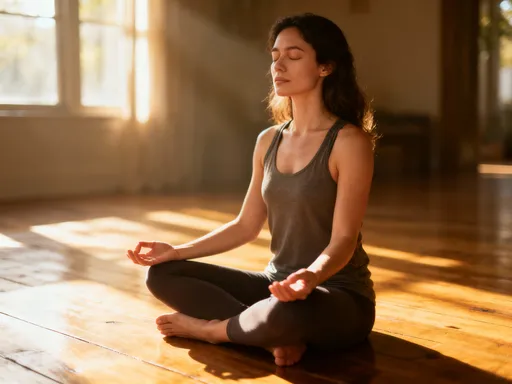
I started by pairing qigong with an existing habit: morning tea. While the water heated, I’d do a few minutes of Lifting the Sky or Shaking the Body. This habit stacking technique made it automatic. On workdays, I used my lunch break to step outside and do Separating Heaven and Earth under a tree. The fresh air enhanced the sense of connection and calm. In the evening, if I felt restless, I’d do a seated version before bed—gentle arm movements while breathing deeply.
I also used a simple reminder on my phone: “Breathe and move.” No pressure, no judgment. If I missed a day, I didn’t scold myself. I simply returned the next day. I learned that self-compassion was part of the practice. Qigong isn’t about perfection; it’s about showing up as you are. Some days I felt present and calm. Other days, my mind raced the whole time. But I still did it. And on those distracted days, I often noticed that by the end, my breathing had slowed, and my shoulders had dropped—proof that the body was benefiting even when the mind wasn’t fully engaged.
The Shift: How My Relationship with Stress Changed
After three months of consistent practice, the changes became unmistakable. I didn’t stop encountering stress—life still brought challenges—but my reaction to it had transformed. Where I once would have spiraled into anxiety, I now had tools to ground myself. A tense meeting no longer left me drained for hours. I’d notice the tension in my jaw, take a few slow breaths, and soften my posture. The storm still passed through, but I wasn’t caught in the center of it.
My focus improved. I could stay present during conversations instead of mentally jumping ahead. I became more aware of my body’s signals—when I was hungry, tired, or overwhelmed—and responded with kindness rather than pushing through. This increased body awareness helped me catch stress earlier, before it built into something unmanageable.
Emotionally, I felt more resilient. Small frustrations didn’t escalate as easily. I had more patience—with my family, with myself. I began to notice moments of quiet joy: the warmth of sunlight on my skin, the sound of birds in the morning. These weren’t dramatic revelations, but a growing sense of inner space. It was as if qigong had gently expanded the container of my daily experience, making room for calm amid the chaos.
The most profound change was subtle but lasting: I no longer felt at war with myself. I wasn’t trying to fix or suppress my stress. I was learning to move with it, breathe through it, and release it. Qigong taught me that healing doesn’t always come from doing more—it can come from doing less, but with greater awareness.
Qigong didn’t erase life’s challenges, but it gave me a way to meet them without crumbling. It’s not a quick fix, but a quiet practice that builds strength from within. For anyone feeling overwhelmed, this gentle tradition offers a science-backed, low-barrier path to calm. You don’t need special gear or hours of time—just a few minutes, some breath, and the willingness to begin. And if I can do it, so can you.